




























60% of Stakeholders Oppose Ex-Ante Competition Rules for Cloud Services Under Digital Competition Bill: CUTS Study
A CUTS International study reveals that over 60% of stakeholders oppose including cloud services under India's proposed Digital Competition Bill, citing regulatory uncertainty, compliance costs, and risks to innovation and investment.


60% of Stakeholders Oppose Ex-Ante Competition Rules for Cloud Services Under Digital Competition Bill: CUTS Study
A majority of stakeholders have voiced concerns over bringing cloud service providers under the proposed Digital Competition Bill (DCB), according to a new study by Consumer Unity and Trust Society (CUTS) International. The report found that more than 60% of stakeholder feedback opposed extending ex-ante competition regulations to cloud services, warning that such measures could create regulatory uncertainty, increase compliance costs, and discourage innovation and investment.
The findings come as the Indian government considers revisiting the Digital Competition Bill, which aims to introduce proactive (ex-ante) regulations to address the dominance of major technology companies such as Google, Microsoft, and Amazon.
Majority Oppose Inclusion of Cloud Services
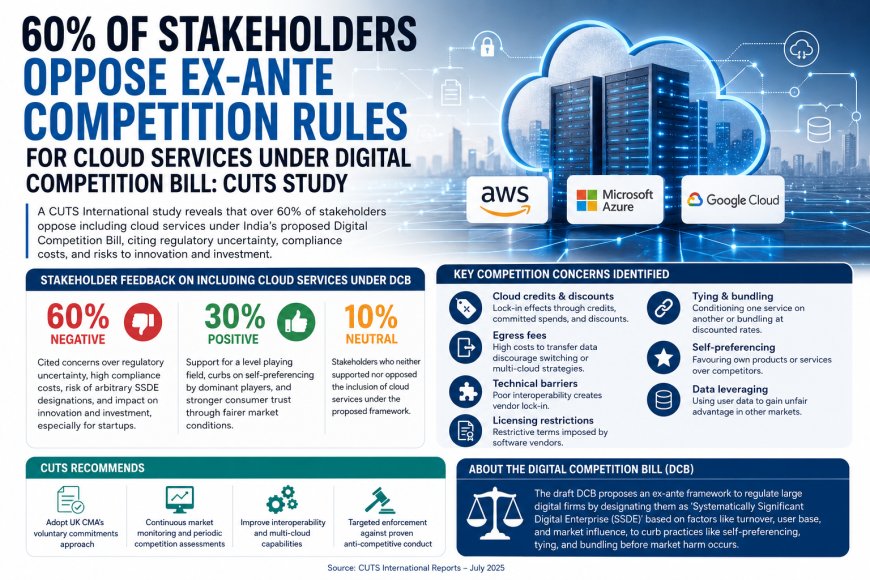
According to the CUTS study, over 60% of respondents expressed negative views on including cloud services within the scope of the Digital Competition Bill. Stakeholders highlighted several concerns, including:
-
Regulatory uncertainty
-
Increased compliance burden
-
Risk of arbitrary SSDE (Systematically Significant Digital Enterprise) designation
-
Reduced innovation and investment
-
Challenges for startups operating with limited resources
Meanwhile, 30% of respondents supported the proposal, arguing that stricter rules could create a more level playing field, prevent self-preferencing by dominant companies, and improve consumer confidence. The remaining 10% maintained a neutral stance.
Government Focus on Sovereign Cloud Infrastructure
The reports arrive amid discussions within the Indian government about encouraging critical sectors such as banking, telecom, and energy to adopt Made-in-India sovereign cloud infrastructure.
The policy discussion reportedly gained momentum after Microsoft suspended services to oil refiner Nayara Energy in 2025, raising concerns over India's dependence on foreign-controlled digital infrastructure. Industry groups have also warned about potential risks associated with foreign cloud platforms, including concerns over possible "kill switch" mechanisms.
Existing Competition Act Can Address Concerns
In its report titled "Competition Concerns in Cloud Services Market and Application of Indian Competition Law," CUTS argued that the existing Competition Act, 2002 already provides the Competition Commission of India (CCI) with sufficient authority to tackle anti-competitive practices in the cloud market.
The report identifies several competition issues, including:
-
Cloud credits and discount-based customer lock-ins
-
High data egress fees
-
Technical barriers and poor interoperability
-
Restrictive software licensing practices
-
Tying and bundling of services
-
Self-preferencing by dominant providers
-
Data leveraging across multiple markets
According to CUTS, these concerns can largely be addressed through the current legal framework and technological improvements rather than introducing broad ex-ante regulations.
Warning Against Premature Regulation
The study cautions that imposing additional regulatory obligations too early could negatively affect India's fast-growing cloud ecosystem.
Researchers noted that India's cloud services market does not currently display the same "tipping" characteristics seen in sectors like e-commerce or food delivery, where a few firms can quickly dominate the market. As a result, the report argues there is insufficient evidence to justify an additional ex-ante regulatory framework at this stage.
CUTS recommends an evidence-based regulatory approach that supports startup growth while maintaining healthy market competition.
Recommendation to Follow the UK's Approach
In a second report titled "[Over] Regulating Cloud Services: A Case for Restraint," CUTS urged India to adopt an approach similar to the UK Competition and Markets Authority (CMA).
Instead of introducing strict ex-ante rules, the report recommends encouraging voluntary industry commitments, including:
-
Waiving or reducing cloud data egress fees
-
Improving interoperability between cloud platforms
-
Launching better multi-cloud management tools
-
Supporting open AI standards
-
Enhancing customer choice without excessive regulation
The report also advises continuous market monitoring, periodic competition assessments, and targeted enforcement against proven anti-competitive conduct.
Price Controls Not Recommended
CUTS also warned against introducing price controls in the cloud services market.
Although the report noted that 84% of businesses experience cloud cost overruns, it argued that price caps could discourage investment, reduce service quality, and fail to account for the wide variety of cloud pricing models.
Instead, the organization recommends greater pricing transparency and stronger multi-cloud support as more effective solutions.
What the Draft Digital Competition Bill Proposes
The draft Digital Competition Bill, submitted by the Committee on Digital Competition Law (CDCL) in February 2024, introduces an ex-ante regulatory framework for major digital platforms.
Under the proposal, companies providing core digital services—such as search engines, app stores, and social media platforms—could be designated as Systematically Significant Digital Enterprises (SSDEs) based on factors including revenue, user base, and market influence.
Once designated, these firms would be required to comply with advance obligations designed to prevent anti-competitive practices such as self-preferencing, tying, and bundling before market harm occurs.
However, the CUTS study suggests that cloud services may not currently require such proactive regulation and that existing competition laws remain sufficient to address most market concerns.
What's Your Reaction?
 Like
0
Like
0
 Dislike
0
Dislike
0
 Love
0
Love
0
 Funny
0
Funny
0
 Angry
0
Angry
0
 Sad
0
Sad
0
 Wow
0
Wow
0